Latino student club La Raza formed University’s first team in 1931
Poking around a Michiana thrift store, history professor Emiliano Aguilar stumbled on a flyer advocating a Notre Dame boycott of Campbell’s Soup in the 1980s. The flyer’s slogan lambasted a “condensed cream of exploitation.”
Intrigued, Aguilar discovered that Notre Dame students had formed a committee and become one of the first major university campuses to boycott Campbell’s Soup in solidarity with Midwestern migrant farm workers.
This foray into school history led Aguilar to connect with Somos ND, an initiative sponsoring a yearlong celebration of the legacy of Latino contributions at Notre Dame. Aguilar co-directed a research team with Gabriela González, assistant director for research and special projects at the Institute for Social Concerns.
In his research, he found a fascinating lost slice of campus sports history. In 1928, about two dozen Latin American students founded a social club called La Raza. Members formed a soccer team in 1931, nearly half a century before soccer became an official sport at the University.
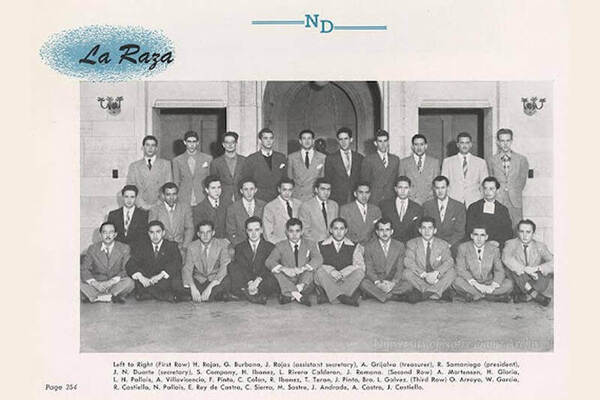
“It becomes for them a way of making this very unfamiliar place, a wintry Midwestern campus like Notre Dame, feel like home,” Aguilar said. “Soccer became a key way of letting people know, ‘This is part of our culture and part of what makes us feel welcomed, so we’re starting our own soccer team.’”
In a 1928 story, the student publication Scholastic said La Raza was formed to “promote close relations and social activities among the Spanish speaking students” and later declared that the team represented one of the “most commendable moves for the introduction of the game at Notre Dame.” La Raza competed against other club teams at schools such as the University of Michigan as well as other primarily immigrant club teams in the region.
Soccer was not widely played at US colleges until after World War II, when it gained popularity mainly in the Northeast. Midwestern schools came on board later, with Notre Dame’s varsity team starting in 1977.
Aguilar, who is in his second year as an assistant professor of history, said his campus research inspired him to learn more about the community he now calls home.
“Since I’ve been here for a couple years,” he said, “I’ve been so fascinated learning—as someone that’s part Latino himself—to really understand what folks like me and their story looks like at a place like Notre Dame and a broader community like South Bend and Michiana.”
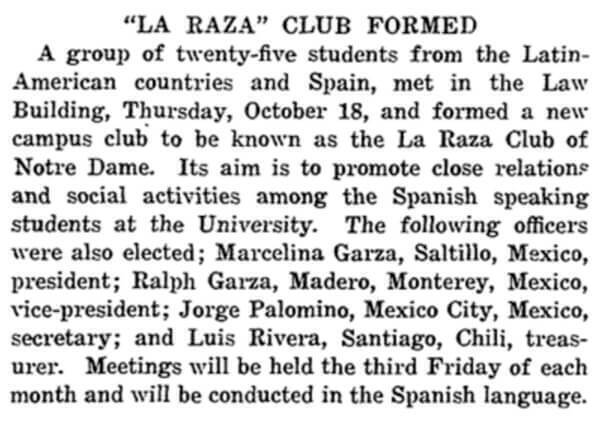
Aguilar’s initial research relied on the archives of Scholastic, a then-weekly student publication that predates The Observer. He also found strong collections in the University Archives, documenting a rich history of Latinos on campus and in the Midwest.
He discovered that La Raza decided to form a soccer team after Jose Martinez, a professor who advised the Spanish Club, gave La Raza a lecture in 1930 called “Football in Spain” about the history of soccer.
Pedro de Landero, a professor of Spanish and a fencing and tennis coach, served as a sponsor for the team. He stayed to teach after becoming one of the early Latino graduates of Notre Dame, a tradition that stretches back to the Zahm trains led by Rev. John A. Zahm, C.S.C.
A far-flung adventurer, Father Zahm returned from Chihuahua, Mexico, in 1883 with the University’s first international cohort of about 75 students, who traveled more than 2,000 miles to South Bend on a chartered train. By 1887, students arriving on Father Zahm’s trains accounted for about 15 percent of the student population, cementing the global reach of Notre Dame.

Notre Dame student Miguel Yriberry, a native of Peru, became the team’s first student manager and had to figure out who they would be able to play. La Raza began competing against other student organizations, such as the Hibernians, an Irish-Scottish club, and local ethnic European teams, such as the South Bend Jays and Mishawaka Merchants.
Another student, Gonzalo Valdes from Spain, was originally a player and captain on the team, but he took on a coaching role in 1934 after suffering a knee injury. “Despite this injury, La Raza recognized Valdes’s passion for the game and commitment to the organization, so they made space for him and allowed him to participate,” Aguilar said.
Valdes expanded the team’s competition and formalized its schedules, reaching out to other Latin American societies. The University of Michigan became one of La Raza’s biggest rivals, and records show it also played teams from the universities of Wisconsin and Illinois.
“We’re seeing Scholastic, for instance, take great pride when La Raza beats the University of Michigan,” Aguilar said. “They also express solid critiques and good wishes and cheers if they lose to Urbana-Champaign, for example.
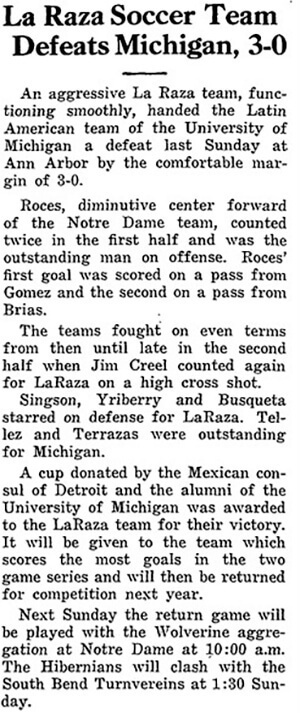
“It’s still an acknowledgment that this is part of the campus culture, that there’s an acceptance in the broader campus culture of this new initiative.”
La Raza organized many campus tournaments, which Aguilar said enabled these Notre Dame students to compete and feel competitive.
“Something that they’re doing, and that they started from the ground up, is getting recognition on campus and in publications, which means a lot to these students living thousands of miles away from home,” he said. “It’s encouraging the campus to partake, for some of these folks, in a new sport of soccer.
“By the time World War II happened, there’s about six club soccer teams on campus that La Raza was competing with. They even organized a competition that they were going to award a trophy as a way to build fellowship.”
Aguilar said the club’s work extended beyond fellowship. Communities and charitable organizations throughout the early 20th century established funds to provide milk to children and families in need.

“La Raza also participated in philanthropic work and organized and competed in milk drives,” he said. “They would play ‘milk fund games’ and donate the proceeds to charities for that local community’s milk fund.”
On a deeper level, Aguilar said, La Raza enabled students to share their Latin American heritage. They would organize lectures about their home countries and host dinners and formals, such as an event to celebrate Día de la Raza, a Latin American alternative to Columbus Day. They traded newspapers that their parents sent from home and published a monthly Spanish newsletter called Amistad, which means friendship.
Despite their success, Aguilar said the club’s soccer momentum faltered after World War II due to an “instructional memory amnesia.” La Raza seemed to no longer be competing by 1948.
“It was hard for students to maintain traditions, cultures, and even student organizations if you have to worry about leadership graduating every year,” Aguilar said. “The soccer team fell off their priorities, and in falling off from their priorities, we kind of forget about it.”
By that time, Aguilar said, soccer was no longer a “niche sport” played by a few ethnic clubs. After Francis Maxwell from Notre Dame’s Department of Physical Education became involved in organizing campus competitions, there was a transition that eventually led to a University club team and varsity sport. La Raza played a leading role in that normalization process.
At the time of the club’s formation, La Raza was recognized and praised for its competition, leadership, and philanthropy, Aguilar said—and he would like to see them recognized today, too. One of his dreams is to find an action picture of the team playing soccer, rather than just formal team portraits.
“I think La Raza is one piece of the broader initiative to recognize that Latin American students have long contributed to the community and respectability around campus,” Aguilar said. “It’s impossible to tell the history of Notre Dame without acknowledging their cohorts who have come to this campus and made it feel more welcoming and like a home.”